Research
Our research focuses on designing AI systems that operate effectively under constrained environments, including limited computation, communication bandwidth, energy, and privacy requirements. We assume execution on edge devices and develop methods that integrate AI, communication, and systems design for practical deployment. Rather than treating computing, communication, and AI separately, we aim to jointly optimize them in an integrated manner.
Adaptive Edge Intelligence (Core)
Objective: To realize intelligent systems that operate on edge devices under real-world constraints such as limited computation, communication, energy, and privacy requirements.
Novelty: Establish design principles that dynamically optimize models, representations, and computation partitioning based on resource and network conditions.
Methods: Model compression, on-device inference and learning, edge-cloud collaboration, federated learning, and uncertainty-aware inference and control.
Results: Prototypes satisfying real-time performance, computational efficiency, and energy constraints, validated via simulation and small-scale demonstrations.
Next: Extend toward AI systems that coordinate with communication environments and broader system-level design.
Keywords
Edge AI, On-device inference, Model compression, Edge-cloud collaboration, Federated learning, Privacy-aware AI
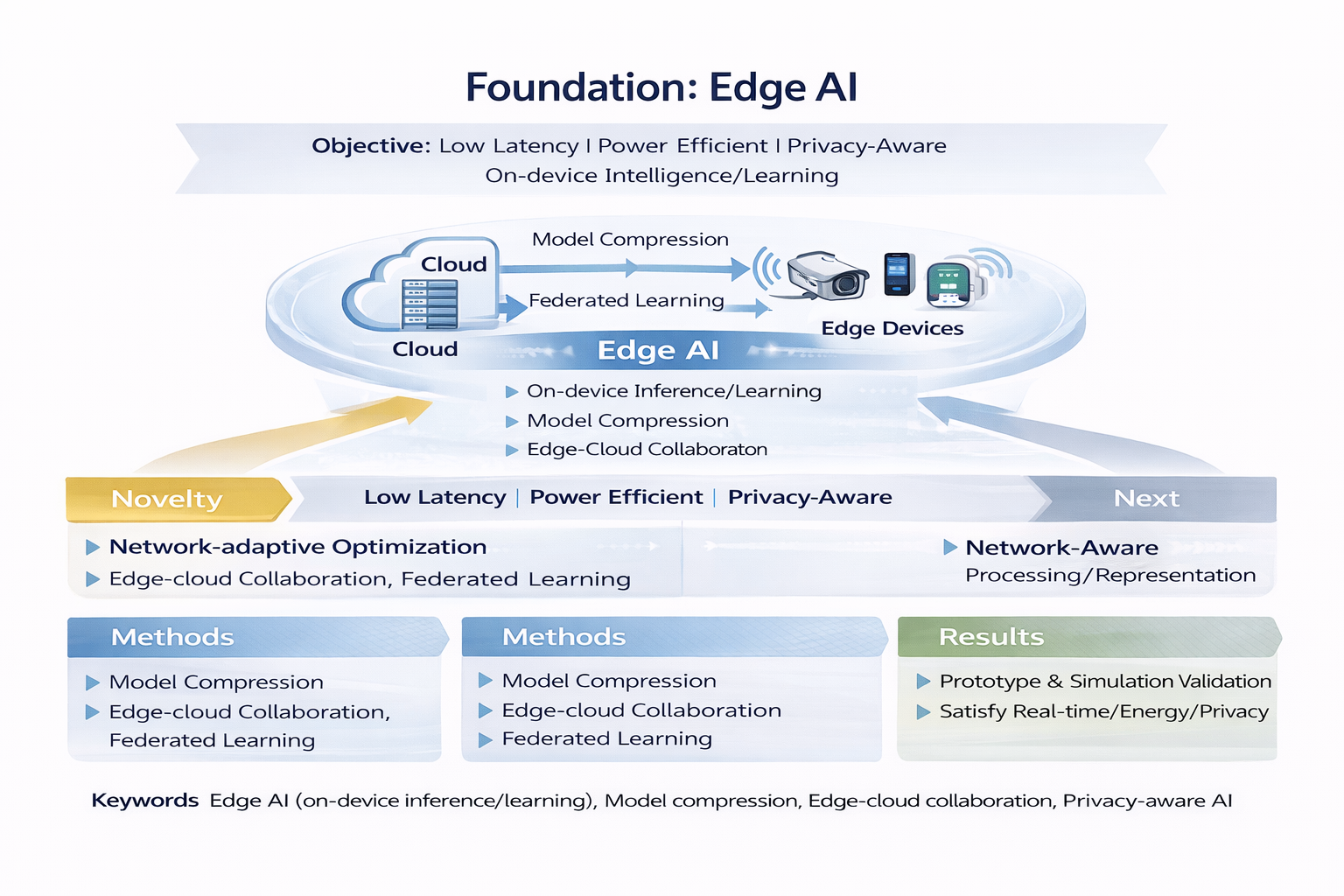
Concept: AI operating on edge devices under real-world constraints
Networked / Resilient Systems
Objective: To design communication-aware and resilient systems in which AI, networking, and distributed control are jointly optimized.
Novelty: Treat communication not only as a constraint, but also as a design target, enabling resilient operation under failures, congestion, and environmental variability.
Methods: Distributed optimization, reinforcement learning, graph neural networks (GNN), service function chain (SFC) placement, and system-level coordination in networked environments.
Results: Quantitative evaluation of latency, reliability, and operational cost, together with systematic design of adaptive and resilient control policies.
Next: Develop unified frameworks that integrate adaptive edge AI with networked and resilient system design.
Keywords
Distributed systems, Resilience, Networked systems, QoS/QoE, Distributed optimization, Traffic engineering, SFC placement
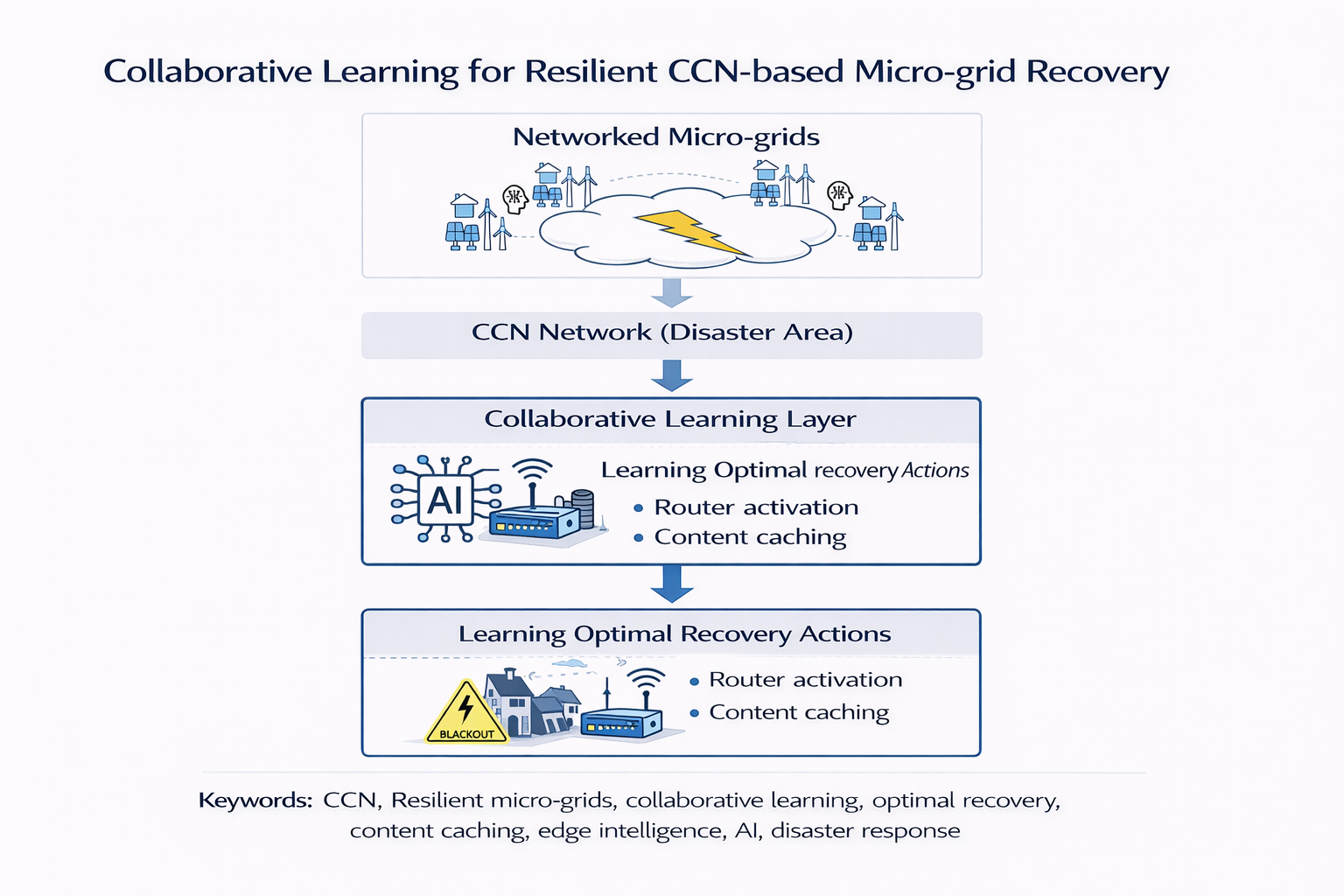
Real-World Applications
Objective: To build practical intelligent systems for real-world environments such as AgeTech, IoT, disaster response, and infrastructure operation.
Novelty: Map heterogeneous sensor data into shared semantic representations robust to missing data, non-IID conditions, and privacy constraints, while enabling deployable system design in realistic environments.
Methods: Semantic representation learning, privacy-preserving learning, real-time edge inference, and adaptive operation in conjunction with communication and system conditions.
Results: Validation through public datasets, simulation, and small-scale prototyping toward practical deployment.
Next: Extend toward resilient real-world systems that remain functional under disruptions such as disasters, congestion, and infrastructure stress.
Keywords
AgeTech, Assistive technologies, IoT sensing, Activity recognition, Fall detection, Semantic representation, Privacy-preserving learning, Disaster resilience
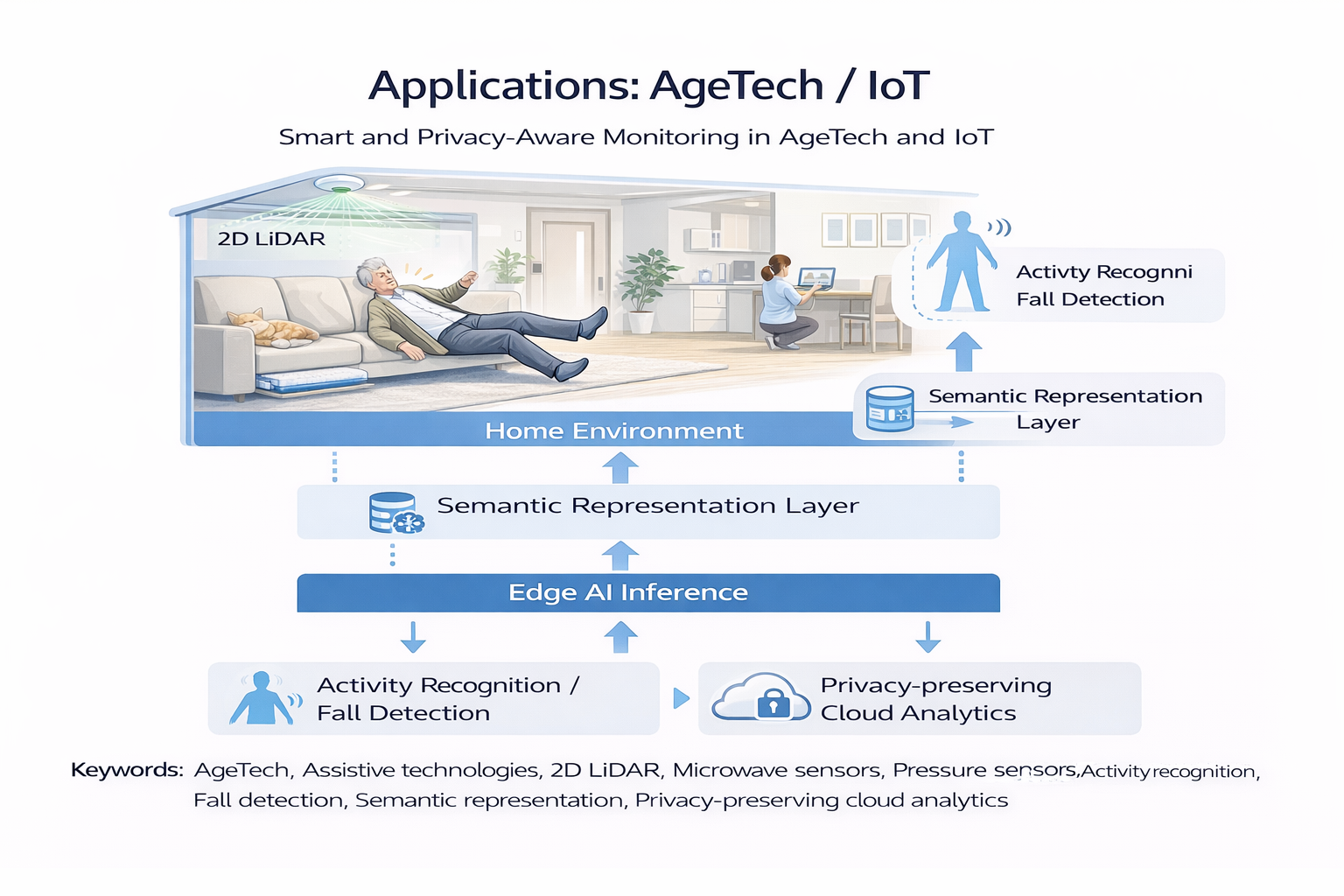
Example: Smart monitoring and assistive systems in real environments